Tuesday, September 1, 2009

DMCI nears completion of Calaca rehabilitation plan

By Donnabelle L. Gatdula (The Philippine Star) Updated September 01, 2009 12:00 AM Comments (0)View comments


MANILA, Philippines - DMCI Holdings Inc., the investment arm of the Consunji group, is nearing the completion of a rehabilitation plan for its newly-acquired 600-megawatt (MW) Calaca coal-fired power plant.
DMCI Power Corp. president Nestor Dadivas said they are now in the final stages of coming up with a rehab program.
The group is awaiting the-turn over of the power plant from the government before they could proceed with the rehabilitation of the facility.
Discussions with the Power Sector Assets and Liabilities Management Corp. (PSALM), a government entity created to handle the sale of National Power Corp.’s assets, are ongoing, he said.
Dadivas said the rehabilitation of Calaca is necessary to maximize the capacity of the plant. Calaca has two units and are currently running at combined capacity of 350 MW.
The Calaca power plant consists of two 300-MW generating units and is primarily designed to run as a base-load plant. It is also designed to utilize local coal from Semirara Mining Corp., a subsidiary of DMCI Holdings.
“We’re studying the plant and we’re finalizing the rehabilitation program because now the plant is running at only around 350 MW,” Dadivas said.
The DMCI official said the group is currently raising the downpayment for the power facility. “We plan to finance it (down–payment) from internally-generated funds,” he said.


DMCI Holdings should be able to pay 40 percent of its bid price of $361.7 million to pave the way for the plant’s turnover.
“We have 270 days to pay the downpayment but PSALM has indicated that we do it sooner so we’re negotiating. Our target is March or April 2010 for the turnover,” Dadivas said.
Earlier, DMCI Holdings president Isidro Consunji said the company is likely to borrow from Banco de Oro to finance a portion of the acquisition price.
DMCI Holdings consolidates all construction business, construction component companies, and related interests of the Consunji family. Its core businesses include construction, real estate and coal mining.
It owns 56 percent of Semirara Mining Corp., which has exclusive rights to explore, mine and develop the coal resources on Semirara Island in Caluya, Antique.
The Calaca facility has been allocated a substantial 287-MW power supply contract, or about 48 percent of the plant’s rated capacity. This will provide DMCI a ready market for the electricity that the power plant will generate.
The Manila Electric Co. will assume the biggest portion of the contracted energy, which is equivalent to 169 MW.

Monday, July 20, 2009

DMCI wanted to solely operate the 600MW Calaca plant

MANILA, July 20 (PNA) — Consunji-owned DMCI Holdings has no plans to look for a partner in operating the 600 megawatt (MW) Calaca coal- fired power plant.
Isidro Consunji, DMCI president said that while they wanted to team-up with other firm, he explained that they are concern on any possible “internal arguments” in the future.
“We want to [get a partner]. But the problem is, if we entertain a new partner today then we might be having internal arguments on how to go forward, as our price is based on a certain strategy (i.e. we don’t intend to run it at 600-MW want to down it for the meantime to be able to rehabilitate what needs to be fixed). We also don’t want to run the plant at the maximum capacity as the plant is already and the wear might be accelerated. And if we get a new partner then we might have problems. Before entertain a partner, perhaps we need to assess where our directions,” Consunji said.
He added the main purpose of the acquiring the Calaca plant was primarily to complement the continued operations of the Semirara Mining Corp., which supplies the coal requirement of Calaca plant.
“Our strategy was defensive, why we had to bid. Prior to last year, we already expanded the Semirara’s capacity. Now we’re geared to 4 to 5 million tons a year. And Calaca represents 1.6 million tons of market. So if another wins then where do the 1.6 million tons go, and thus we will be forced to export,” he said.
He added “export price is lower than local price and will make our profitability suffer.”
During Semirara’s initial operation, Consunji said “99 percent of Semirara’s coal goes to Calaca and now we were able to bring it down to 20 percent.”
Likewise, Consunji said they are also not keen on utilizing the entire 600-MW capacity of Calaca which has a dependable capacity of 470MW even after rehabilitating and upgrading it.
According to Mr. Consunji, they are now in talks with various financial institution in particular the Banco de Oro to fund the US$ 361.7 million acquisition.
“BDO is one of the banks talking with us. We plan that it will be shared by Semirara and DMCI, but bulk of the equity would be Semirara since they are the biggest beneficiary,” he said.
DMCIHI has 56 percent stake in Semirara, which has exclusive rights to explore, mine and develop the coal resources on Semirara Island in Caluya, Antique.
DMCI’s offer defeated Thailand-based firm Banpu Power Limited.
Established in 1995, DMCIHI is engaged in construction business, construction component companies, and related interests of the Consunji family. Its core businesses include construction, real estate and coal mining.
Consunji said they expect the Power Sector and Assets Liabilities Management Corp. (PSALM) to issue the notice of award this week and in the next 270 days, the company will pay the 40 percent upfront payment.
National Power Corp. has attached around 287-MW supply contract to Calaca or an equivalent of 48 percent of the plant’s rated capacity.
Meanwhile, Consunji said once they have completed the acquisition of Calaca, they will enter the wholesale electricity spot market (WESM).
“We will participate in the WESM. And with the privatization of Calaca,” he said.
Last week, PSALM declared DMCIHI as the highest bidder for the Calaca plant and once the verification process is completed, they will be declared as the winning bidder. (PNA)

Wednesday, June 17, 2009

Semirara mercury safe, says coal firm

By Nestor P. Burgos Jr.
Inquirer Visayas
First Posted 01:06:00 06/17/2009

Filed Under: Environmental Issues, Pollution, Mining and quarrying

ILOILO CITY -- Semirara Mining Co. (SMC) has disputed findings of University of the Philippines scientists showing toxic levels of mercury in areas on Semirara Island in Antique.
Juniper Barroquillo, SMC administrative manager, said the company’s own studies had shown that mercury levels were within tolerable and safe levels.
Deadly element
“Their findings are wrong. We have already conducted monitoring on the mercury levels,” Barroquillo told the Philippine Daily Inquirer in a telephone interview on Monday.
Scientists and researchers from UP Visayas (UPV) said last week that soil samples taken from areas near the mining operations showed that the mercury content reached “moderate toxicity” level, which was safe to animals and humans.
Mercury poisoning could cause damage to the nervous system and permanently damage the brain, kidneys and fetuses, according to the scientists.
The samples, which were analyzed at the Research and Analytical Services Laboratory of the Natural Sciences Research Institute and the National Institute of Geological Sciences in UP Diliman, also showed high concentrations of coal in the soil especially at the mouth of the Suja Creek in Barangay Semirara, one of the three villages of the 5,500-hectare island.
Environmental groups and some islanders have blamed decades of coal mining operations for the massive siltation that has destroyed their coastal and marine resources, including mangroves.
Denied allegations
But SMC, which took over the mining operations from the government-owned Semirara Coal Corp. (SCC) in 1999, has repeatedly denied the allegations and pointed at old stockpiles of SCC as the cause of siltation.
The Department of Environment and Natural Resources (DENR) in Western Visayas issued conflicting reports on allegations of pollution on the island.
A report of its Community Environment Officer (Cenro) has belied allegations of siltation and death of mangroves.
But on February 15, the Environment and Management Bureau (EMB) of the DENR regional office recommended to the Pollution and Adjudication Board the issuance of a cease-and-desist order for SMC to close its coal washing plant.
‘Prima facie evidence’
The memo, issued by then regional director Bienvenido Lipayon, cited “prima facie evidence” that SMC was disposing of coal wastes into the Suja Creek and the sea.
The EMB has not reacted to the findings of the UP scientists. Oscar Cabanayan, EMB regional director, did not respond to repeated calls and text messages from the Inquirer.
Prevention
Barroquillo said SMC had taken steps to prevent further siltation from old coal stockpiles.
He said the company had also transferred its coal washing plant to the Panian mining pit at the cost of P200 million. It would be operational before the end of the month.

Thursday, May 28, 2009

DMCI may pull the plug on new Visayas plant


DESPITE an impending supply shortage in the Visayas, DMCI Power Corp. may cancel a plan to put up a coal-fired facility in the Western part of the region, according to the operator of the country's wholesale electricity spot market (WESM).
"The indications point to a withdrawal," Melinda Ocampo, acting president of the Philippine Electricity Market Corp. (PEMC) and a consultant to the Department of Energy, said, citing DMCI Power's failure so far to sign supply deals with potential offtakers.
DMCI Power is the power generation arm of DMCI Holdings Inc., a local conglomerate engaged in construction, real-estate development and coal mining. The company earlier proposed to put up a 100-megawatt coal plant in Conception, Iloilo on Panay Island at a cost of about P7 billion.
The coal facility would use circulating fluidized bed technology-or "clean coal technology"-and would tap coal from Semirara Mining Corp., another DMCI unit based in Antique.
DMCI Power was already in talks with several banks for financing the coal plant but negotiations failed to move because of the firm's inability to sign a supply agreement with the island's electric cooperatives.
The plant was scheduled to come online in two years to help address the Visayas grid's critical power supply, which has already caused outages in the region.
"We're expecting DMCI Power to come in by 2012, 2011. Unfortunately their problem is more on the offtaker," Ocampo said.
DMCI Power last year offered to supply 90 megawatts to electric cooperatives in Panay but sources said that most of the distribution utilities in the Visayas were keen on renewable energy sources.
Despite this, Ocampo said the energy department has yet to receive a notice from the company if it would drop the project.
"I don't know whether they will still push through with it but when it comes to the department, we have not yet received any formal or official notice from them that they are withdrawing," she said.-- Euan Paulo C. Añonuevo

Tuesday, April 14, 2009

DENR issues CDO vs Semirara coal washing plant

By Nestor P. Burgos Jr.
The Department of Environment and Natural Resources (DENR) in Western Visayas has recommended the issuance of a cease and desist order (CDO) on the coal washing plant of the Semirara Mining Corp. for allegedly polluting Semirara Island's waters and mangroves.
In a memorandum issued by its Environmental Management Bureau (EMB) to the Pollution and Adjudication Board endorsing the complaint of residents against the alleged pollution, the DENR said there was “prima facie evidence” against the company on the “disposal of coal material and tailings into the Suja Creek and to the sea.”
The memorandum dated February 15 and issued by DENR-EMB Regional Director Bienvenido Lipayon also recommended that the company be required to institute interim and long-term measures to prevent a recurrence of the problem.
Residents of Sitio Bigo in Barangay Alegria, one of three villages of the island, had earlier filed a complaint alleging that coastal resources including mangroves have died or have been contaminated by wastes coming from the coal washing plant of SMC.
Semirara is one of the nine islands comprising Caluya town in Antique at the northern end of Panay Island. It is considered one of the richest fishing grounds in the area.
The residents alleged in their petition that silt has covered their coastline and mangroves as waste coming from the company's coal washing plant goes directly to the sea because the siltation pond has not been operational for a long time.
The company, which has been operating one of the biggest coal mines in Asia on the 5,500-hectare island, has repeatedly denied that the company's siltation pond has been non-functional.
It said that the siltation was caused by several typhoons that have affected the island which have triggered runoffs from old coal blending stockpiles.
The company also said that it has implemented corrective measures including the construction of a wall along the stockpile to prevent the erosion of coal towards the shoreline. It also said that its coal tailings pond has undergone maintenance and improvement to contain the tailings from the coal washing plant.
But the EMB said the discharged of coal materials from the coal blending stockpile and tailings from the coal washing plant violated Section 27 of the Clean Water Act (Republic Act 9275) which prohibits the discharging or depositing of materials into bodies of water that could cause pollution or obstruct the natural flow of water.
“The respondent (SMC) failed to provide the necessary barrier or catchment to prevent the coal blending stockpile from being washout by runoff to the receiving water body and likewise operating improperly the tailings pond serving the coal washing plant thereby discharging black silt materials to the water body,” Lipayon said in his memorandum.
The EMB has also recommended that DENR issue a fine of P45,000 against the SMC for violating three conditions of its environmental certificate of compliance (ECC).
The EMB said a study should be conducted to determine the extent of damage and destruction of seagrasses and aquatic resources. An inventory and rehabilitation of mangroves should also be conducted.
The Multi-Partite Monitoring Team (MMT), headed by the Department of Environment and Natural Resources is set hold a meeting and field investigation in Semirara on April 16-18 to further investigate the allegations.
A separate and parallel investigation will also be conducted by environmental groups and scientists upon the request of the complainants.

Friday, March 27, 2009

Semirara Disaster

semirara-map1
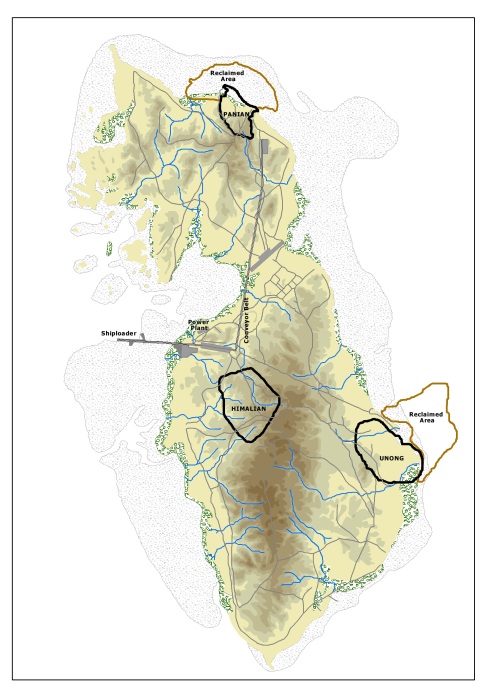
Map of Semirara Island, Sitio Bigo, Brgy. Alegria is south of the shiploader. The Unong Pit was the 1st operated in the 1980s until 1998, the 2nd pit (Panian) is still in operation. Himalian is the proposed 3rd pit.
tao-1481
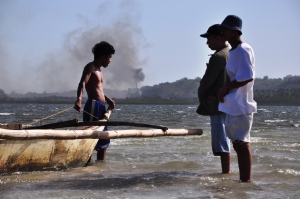
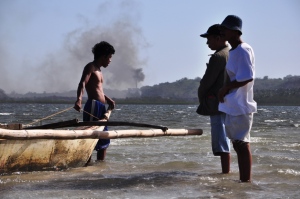
Backdrop is the 15 MW coal-fired power plant. The black-bottom of the fisherman’s banca  indicates the coal residue in the waters.
shore-coal2
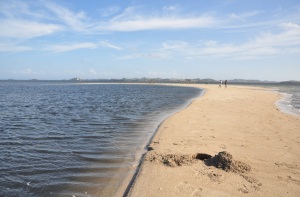
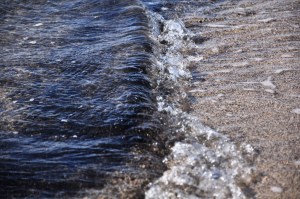
Virtual reclamation caused by the refuse / tailings from the coal washing facility. Note the black color of the sea with coal-bits lining the shore.
tao-133
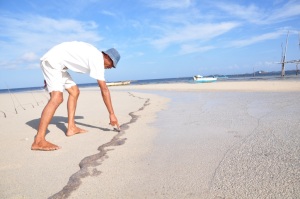
Coal bits brought by the tide to the white coralline shore.
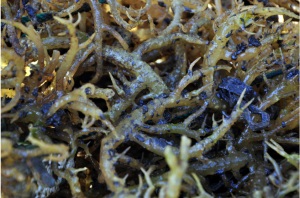
seaweeds-disease2
Seaweeds suffer from the coal residue.
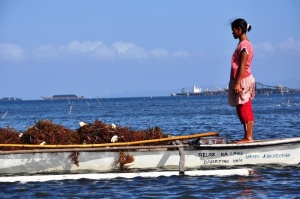
tao-729
Seaweeds is a major livelihood of the communities.
skin-disease
Even the fisherfolks suffer from the coal-residues with sore skins.
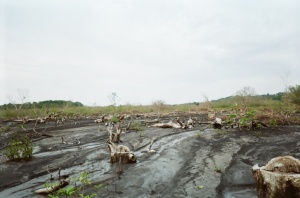
36290016
Dying mangroves cut, burned and bulldozed over.
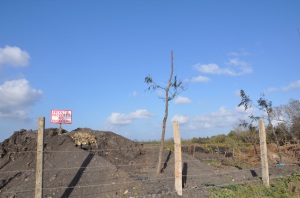
tao-a
Former mangrove areas that were bulldozed have been fenced-off and planted with coconut trees.

Sunday, March 15, 2009

A Statement on Coal Waste in Brgy.Alegria, Island Semirara

THE ANTIQUE OUTDOORS, INC.
2ND  Floor  Pedriña Nietes & Liu Chiang Law Offices
Business Park, San Jose de Buenavista 5700, Antique
Tel/Fax (036) 5405585 / (036) 3201980   email: taoincorporated@yahoo.com
A STATEMENT ON COAL WASTE IN BRGY. ALEGRIA, ISLAND OF SEMIRARA
After years of muffled grievance – amidst the haze of coal dust – a community finally has enough.  A hundred or so residents of Sitio Bigo, Alegria in September 2008 signed a petition against coal mining pollution in their community. The petition, addressed to DENR Sec. Lito Atienza, bewails of the destruction of mangrove forest and the contamination of the beach coming from the coal washing plant of the Semirara Mining Co. (SMC). Their livelihoods of fishing and seaweed growing have been badly affected due to the contamination. It endangers their health.
Coal mining operations on Semirara Island over the years produce many unresolved issues on pollution, destruction of marine ecosystems, false promises and displacement of communities, and so on. Coal itself is the dirtiest of all fossil fuels, releasing carbon dioxide into the atmosphere.
Reacting to the issue appearing in a major daily, SMC accuses complainants of maligning the company so that it would be pressured to give money to them. In effect, SMC tells us that it is falling prey from extortionist people of Alegria. The SMC really knows how to rub salt in the wound.
SMC went on to say that a typhoon destroyed the mangroves and that they have replanted them. Thanks but no thanks.  Mangroves have withstood nature’s fury long before SMC started it operations on the island. On the contrary, mangroves stand to protect coastal communities from strong waves, winds and floods. Of course, mangroves and other marine ecosystems stand no chance against man’s greed and blatant disregard of law.
Questions arise from this issue. What did the Multi-partite Monitoring Team (MMT) do to this problem? The destruction caused by the SMC is a palpable violation of environmental laws. Inaction on the part of MMT constitutes neglect. This culpability warrants legal sanctions, both for SMC and the MMT.
In an interview over a radio station, Mayor Reynante Lim of Caluya is too fast to SMC’s defense. He said the complaints are fabricated. Why his hundred or so constituents would do such a fabrication, he did not explain. Perhaps the many pictures that show mangroves dying on black silt were fakes. Or the signatures in the petition are forged? Or perhaps his true constituency lies on SMC?
Only Barangay Captain Ronald Lavega of Alegria has the courage to raise an accusing finger. In an era of double faced politicians, and on an island where M-14-totting “security men” roam around, his is a rare display of true leadership. We know that not only guns mute the weeping on this island. Cash clinks loud to silence all – from the local government units and concerned government agencies.
If the government fails to uphold its mandate, the people hope the church to step in. Pope Benedict himself issued an edict deploring environmental pollution as one of the new seven (7) deadly sins. This is not to mention greed.
It is puzzling the SMC could not spend on putting up a working washing plant or rehabilitating the ecosystems. It is benevolent enough to donate for the construction of churches or other church projects. Are the parishioners puzzled too over the silence of the “moral force”?
To whom then the beleaguered residents of Sitio Bigo turn? The Sangguniang Panlalawigan so far listened. We commend them for passing a resolution indorsing the petition, thru its sponsor Hon. Bobot Santillan.
We hope that, in a discordant political landscape, the SP Members remain steadfast over this concern. Environmental protection transcends political affiliation. This is about climate change, the conservation of our natural heritage, the future of our children, even unborn. This is about justice long past due.
We call the attention of Governor Perez and Congressman Javier. The issue provides opportunity for both of them to prove their consistency on environmental protection. Or at least to prove that their lowly constituents enjoy their protection.  Not of a pampered company.
Moreover, it is to prove that Antiquenos did not squander their struggle against the shameless waste-dumping proposal by the same polluters on the same island nine years ago.   Despite of their leaders.
Let truth and justice prevail on Semirara Island. Environmental laws are the most violated and neglected of all laws. We call on the rehabilitation of the destroyed marine ecosystems and the compensation of the affected communities and let the violators, including government officials guilty of misfeasance, answer the full force of the law.

Friday, February 20, 2009

DMCI’s ‘CLEAN COAL’ a farce!

caluya-beach
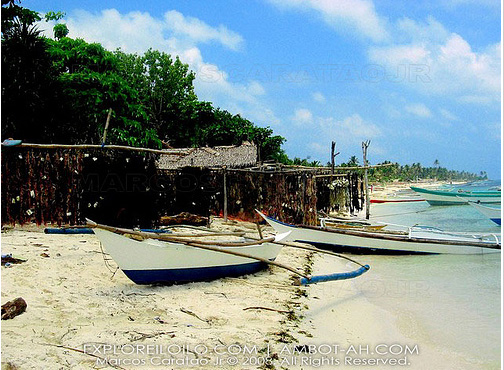
Upper right picture shows the typical shoreline of the Caluya group of islands (source: http://www.exploreiloilo.com/caluya-a-paradise-beyond-boracay.html).
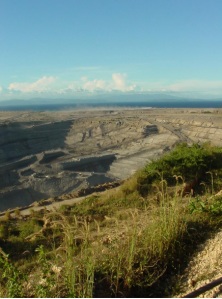
panian-pitThe main source of livelihood of the people of Caluya, Antique are fishing and seaweeds production. In 1998, DMCI opened the second pit, Panian, in Brgy. Semirara (upper left picture) by open strip mining. Semirara coal are used mainly by power and cement plants. Because of the outcry on the environmental and health impacts of burning coal, DMCI adopted the marketing gimmick of ‘CLEAN COAL’ technology. Literally, DMCI started washing the coal of impurities in 2005.
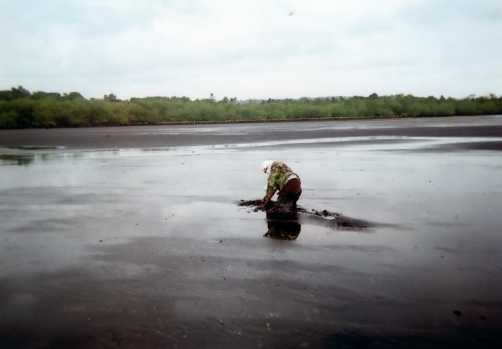
However, the wastes from the coal-washing facility were dumped to the sea turning the white beach into black (picture below) killing the mangroves and seagrasses and driving away all marine life including the Dugong. This illustrates there is no ‘CLEAN COAL’ – but blatant ‘green washing’ gimmicks to fool the public.
img0263
The residents petitioned DENR Secretary Atienza in September 2008 to compell DMCI to rehabilitate the area, provide alternative livelihood to the fisherfolks and compensate the affected communities for damages.
DENR issued DMCI a ‘Notice of Violation’ and scheduled an MMT (multipartite monitoring team) field investigation on March 16-18, 2009 and a hearing on the EGF (environmental guarantee fund) on March 19. DMCI is now trying to cover the area by bulldozing topsoil and planting coconut trees.
Expose DMCI’s environmental crimes!
Justice to the people of Semirara!

Tuesday, February 17, 2009

Semirara Mining Corp. Plans To Export 2.5 Mln Coal Mine This Year

Mining Exploration News
Semirara Mining Corp., owned by the Consunji family, plans to export 2.5 million metric tons of coal this year, company officials said.

Cesar Villanueva, marketing manager, told reporters that Semirara would export coal to India and Thailand.
He said Semirara Mining aimed to raise production to 5 million MT this year, with half of the output to be sold in the local market and the other half to be shipped out.
An official earlier said the company was focusing its attention on India, China and Hong Kong for the coal exports. Semirara had exported some 800,000 MT to the three markets.
Semirara’s local customers, meanwhile, include Global Power, a member of the Metrobank Group of Companies, Mindanao coal plant owned by STEAG State Power, Aboitiz Group Asia-Pacific Energy Corp., majority-owned by Formosa Heavy Industries Corp. of Taiwan, cement plants and other companies.
The company supplied the requirements of the 600-megawatt Calaca plant in Batangas until the deterioration of the power facility.
Suez Energy of France, the company that won and later forfeited the auction for the Calaca plant, claimed that the use of coal from Semirara to fire the facility contributed to the severe deterioration of power facility.
Villanueva said Semirara had started exporting coal to India by batches of around 50,000 MT per shipment.
Villanueva said the company “bought new equipment” to increase its production volume target this year, which is about 50 percent higher than 3 million MT in 2008.
He said declining oil prices in the world market had cut down local coal prices by 30 percent.
The Energy Department earlier extended Semirara Mining’s coal operating contract in Antique by another 15 years to 2027.
Semirara Mining incorporated on Feb. 26, 1980 and offered its shares to the public in 1983. On July 11, 1977, the government, through the Energy Development Board, now the Energy Department, awarded a 35-year coal operating contract to a consortium that subsequently assigned the coal operating agreement to Semirara.
The coal operating contract, which was amended by an agreement dated June 8, 1983, gave the company the exclusive right to conduct exploration, development and coal mining operations on Semirara Island until 2012.
The mining company is one of the four major subsidiaries of DMCI Holdings, the investment vehicle that consolidated all construction business, construction component companies and related interests of the Consunji family.
The other major subsidiaries of DMCI are D.M. Consunji Inc., DMCI Project Developers Inc. and Atlantic Gulf and Pacific Co. of Manila Inc.